Why an Old Tree Can Feel Like Standing Beside Something Sacred
You don’t have to be religious to feel reverence. You don’t have to be spiritual in any formal sense to stand beside an ancient tree and feel small in the most human way. If you’re like the poet Emily Dickinson, writing during the American Renaissance, you can feel sense of divine reverence just by being in nature itself. Writing in 1864, Dickinson extolled the virtues of nature for communing with the divine:
“Some keep the Sabbath going to the Church —
I keep it, staying at Home —
With a Bobolink for a Chorister —
And an Orchard, for a Dome —”
Here, Dickinson suggests that rather than going to church, she'd prefer an Orchard to a man-made dome, i.e., a church. And the truth is that Emily Dickinson never actually joined a church, resisting her family's pressure to do so throughout her life. Why? Although Dickinson was writing at the end of the Calvinist influence in early America, she was still a part of a discussion of between the transcendentalism that grew out of early America via Emerson and Thoreau and the Romantic Sublime that began across the pond in England with the Romantic poets like Shelley and Wordsworth.
For the Romantic poets, nature’s vastness, power, and grandeur provokes feelings of awe, terror and even spiritual transcendence. Wordsworth famously wrote in The Prelude, “The soul / Remembering how she felt, but what she felt / Remembering not, retains an obscure sense / Of possible sublimity", i.e., that nature as the sublime is indelible and leaves a permanent etching in the human mind. While gazing on Mont Blanc, the highest mountain in the Swiss Alps, Shelley was struck with awe and reverence at the site of such a massive, beautiful and pure mountain in the snow: “The everlasting universe of things / Flows through the mind, and rolls its rapid waves, / Now dark—now glittering—now reflecting gloom.” Here is plainly suggests that “the everlasting universe of things” (God) flows through all of nature.
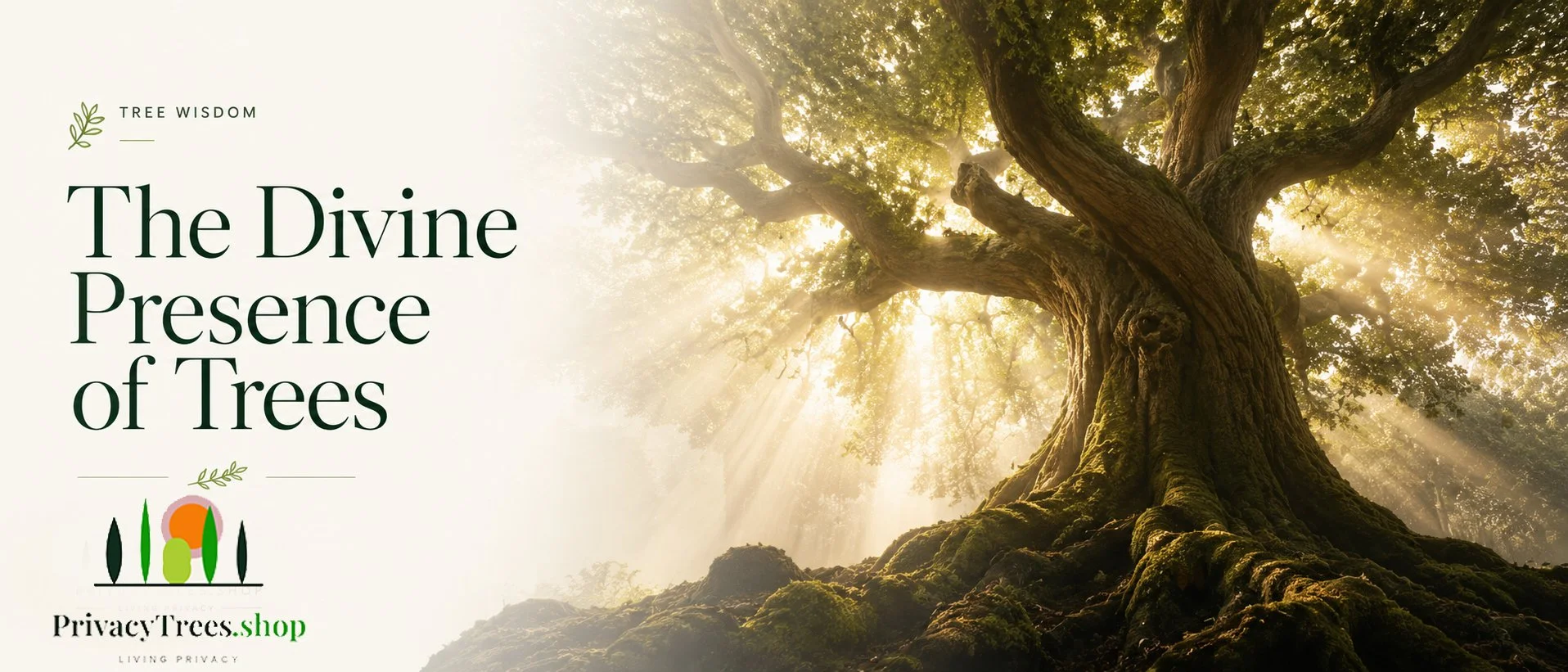
Like Shelley, staring up at the highest peak in the Alps covered in pristine snow with a sense of profound awe, it’s natural to stare at a massive and ancient tree and feel a sense of the Romantic Sublime, i.e., that you're in the presence of something otherworldly, even divine. Something that makes you feel a sense of awe and transcendence that nature itself is replete with the divine.
Why We Stop Seeing Trees
Yet despite the fact that trees are imbued with the divine, most people don't see the trees that are all around them.
Indeed, for most of human history, trees have been treated as useful things: timber, shade, fruit, ornament, fuel, boundary, screen. Valued only in as much as they could give us or provide for us. To put a point on it, it’s estimated that humanity has cleared or cut down 46% of the world's 3.6 million trillion trees and we cut down about an average of 15 billion trees a year. Most of these trees (37%) are lost to clear cutting is solely for the purpose of timber harvesting or logging to used for housing, furniture, tools, etc. The destruction of the world's trees is having a huge impact on humanity and the world. It’s intensifying climate change, causing loss of both human and animal populations, and increasing soil pollution.
Even now, most people pass trees every day without really seeing them. To the average person, trees are simply background. Simply landscaping. Think about it. When was the last time you really looked at the trees in your yard or on your street? When was the last time you truly noticed them?
The short answer is that trees are overlooked because we don’t truly see them as living beings. Trees become less than because they don’t move like us, speak like us, or live on our hurried human timeline. Simply put, they remain unseen because they aren’t easy or obvious. To see a tree requires a certain amount of discernment, openness, and wonder. Three traits a person rarely possesses in isolation and even more rarely together.
But what if that way of seeing is wrong? What if the beings we have considered beneath us are, in some ways, above us?
What Trees Quietly Do for the World
The question, "What do trees quietly do for the world?" is a loaded one because answering it is an impossible task. It’s too difficult to answer because there is a limitless list of things trees do. But we could start with a short list:
For starters, trees make this world habitable: They help create the air we breathe. This is a big one, so let’s unpack it. Most people know that trees generate oxygen in the process called photosynthesis. In fact, a single mature leafy tree produces enough oxygen in a single season to support 10 people for a year. They not only produce oxygen as a byproduct, but they also clean the air itself. Not many people know that leaves actually pull particulates out of the air (dust, soot, exhaust), absorb gas pollution, and reduce carbon dioxide in the atmosphere. In other words, trees are nature’s biological oxygen filters, effortlessly cleaning the air around you without your knowledge. If you live near a woods or walk through one frequently you may be able to forgo that expensive air purifier you had in your Amazon shopping cart.
They make it rain: That’s right, trees are largely responsible for the global hydrological cycle. Trees essentially take in vast amounts of water from the ground through their massive root systems and then transpire that water or release that water through their leaves. The moisture they produce through transpiration actually produces clouds and creates regional weather patterns. Yes they're responsible for the rain in your local environment, which means essentially they’re responsible for replenishing agricultural water sources. They make it possible for us to actually grow food. Okay, so that means trees not only give us the air we breathe, but also the food we eat.
They cool the land: If that isn't enough, just think about the fact that they're also responsible for cooling local environments. Trees are nature's natural air conditioners. “Shade trees” provide shade, but all trees reduce temperatures by releasing water vapor that absorbs heat. An urban street lined with shade trees can reduce the ambient temperature by up to 9 degrees. A dense forest can reduce temperatures by up to 15°! Okay, so trees enable us to breathe and to eat, but now you know they also keep us cool.
They hold soil in place: Why is holding soil in place important? Well it not only keeps the soil from eroding, which is critical for every aspect of life, but it also provides topsoil. In particular, decaying leaves and other debris from trees drop and create the layer of soil that feeds beneficial bacteria, fungi, and and worms necessary for agriculture.
They shelter countless forms of life: Forests and tree canopies actually house or support 80% of all land-based plants, animals, and birds. Critical among these are pollinators, which are responsible for 70% of global food types , 35% of total global food production volume, and 90% of food nutrient quality. They also house predators such as birds that actually eat insects that help us prevent crop damage and destruction. At first glance, when you walk through a forest, it may look silent, but it’s actually teeming with life. You just need to look carefully and with discerning eyes.
Beyond all of the benefits they give us, trees also just live a really long time. They endure beyond generations. Some may live for thousands of years. Some may not be bound by ordinary death in the way we are.
That should humble us. A tree does not need to be human to be worthy of respect. It does not need to speak our language to have presence. It does not need to move quickly to be alive. It does not need to resemble us to matter.
Maybe trees feel divine because they remind us of what we are not: ancient, patient, rooted, enduring, generous, and quiet. They reveal the smallness of a human life, but not in a cruel way. They make our mortality visible, and in doing so, they make our humanity more tender.
Standing Beside Something Ancient
To stand beside an old tree is to stand beside time. To touch its bark is to touch a life that may have witnessed more than we can imagine. To plant a young tree is to make an offering to a future we may never see.
That is why a living privacy screen is not just a screen. It’s a row of young beings entering into time. It’s a future wall of shade, oxygen, shelter, memory, and presence. It is a living boundary that asks something of us in return: attention, care, humility, and respect.
Ought we not honor their right to be here? Ought we not ask what they have to teach us?
Go touch a tree. You may be standing beside one of the quiet gods of the earth.
You Might Also Like