Getting to Know Your Trees: A Guide to Noticing Individuality
You Get to Know a Tree by Returning
Most people are used to seeing trees as background, like wallpaper. They line the street. They fill the edge of a yard. They stand behind houses, fences, roads, sidewalks, and fields. They’re always there, so quietly present that many people stop seeing them at all.
But a tree is not background. A tree is alive. And once you begin paying attention, you start to realize that no two trees are exactly the same, even when they belong to the same variety.
At PrivacyTrees, this is why our mother trees have names. We don’t name them because it sounds cute. We name them because we know them. We know how they arrived. We know how they handled stress. We know which ones rooted quickly. We know which ones struggled. We know which ones pushed new growth when we least expected it. We know which ones held their color through cold, heat, red clay, drought, delay, and recovery.
That kind of knowing begins with attention.
Look at the Tree, Not Just the Type
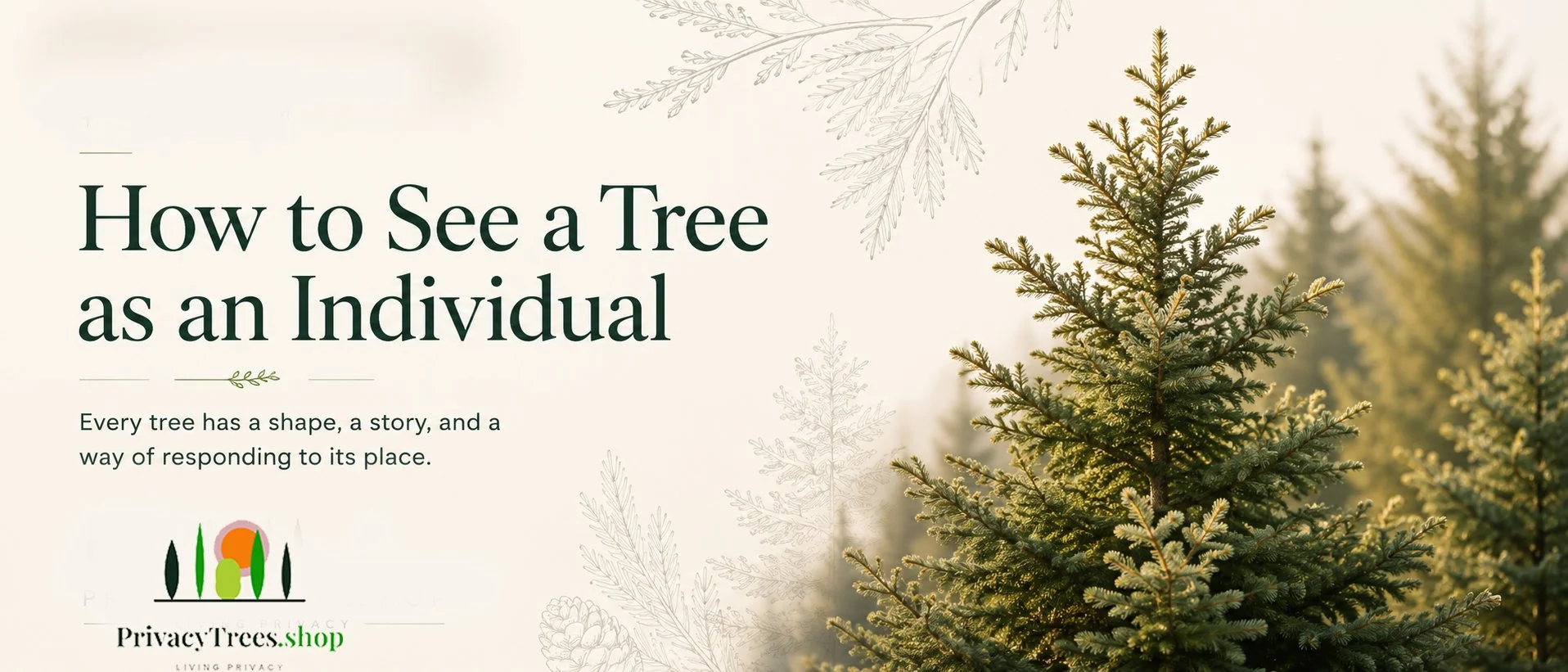
Look at this tree, not just this type of tree. It is easy to look at a row of evergreens and think, “Those are Thuja trees,” or “Those are Leyland Cypress,” or “Those are privacy trees.” But that is only the category. The real relationship begins when you look at one tree at a time.
Not the row. Not the variety. Not the product name. This tree.
Stand in front of it for a few minutes and notice what makes it different from the tree beside it. Is it narrow or wide? Is it dense or open? Is it upright, leaning, layered, rounded, feathery, formal, wild, soft, or sculptural? Does it grow evenly on all sides, or does one side reach more strongly toward the light? Does it feel young and awkward, or settled and grounded?
You don’t have to force a personality onto the tree. Just look long enough to let its differences become visible.
What to Notice: Shape, Color, Texture, Scent, and Presence
Notice the shape. Every tree has a structure. Some trees grow like columns. Some grow like fountains. Some have branches that lift upward. Some sweep outward. Some layer themselves like skirts. Some stay tight and formal. Some grow loose, open, and unexpected. A tree’s shape tells part of its story.
Notice the color. Green is not just green. Some trees are deep blue-green. Some are bright yellow-green at the tips. Some are darker inside and lighter outside. Some hold their color through winter. Some bronze, pale, fade, or brown when stressed Some transform in to bright red flaming beacons in fall.. Some flush with new growth so suddenly that they seem to change overnight.
Notice the texture. Touch the foliage gently. Some evergreen foliage is soft and flat. Some is feathery. Some is glossy. Some is sharp. Some is dense and layered. Some is loose and airy. Touch the trunk if the tree is large enough. Feel the bark. Notice whether it is smooth, ridged, fibrous, peeling, rough, cool, warm, dry, or damp after rain.
Notice the scent. Many trees have their own scent. Some smell clean. Some smell resinous. Some smell sharp, citrusy, spicy, earthy, sweet, green, or faintly medicinal. Some smell strongest after rain. Some release scent when you touch the foliage. Some are subtle unless you slow down.
Notice how it handles stress. A tree’s individuality often shows most clearly under pressure. How does it respond to cold? How does it handle heat? Does it brown after transplanting? Does it recover? Does it push new growth after a hard season? Does it stall? Does it thicken from the base? Does it keep reaching upward?
Notice its presence. Some trees feel protective. Some feel graceful. Some feel old, even when they are young. Some feel steady. Some feel playful. Some feel dramatic. Some feel private and enclosed. Some feel open and welcoming. You do not have to explain that feeling perfectly. You only have to notice it.
Watching the Same Tree Over Time
You can’t know a tree in one day. You learn a tree by returning to it over and over again. Look at it after rain. Look at it during heat. Look at it in winter. In the spring. When new growth appears. Or after pruning or a storm.
Over time, you’ll begin to recognize its habits. One tree may push new growth early. One may grow quietly, then surprise you with a new leader. One may stay dense and steady. One may open up in shade. One might lean toward the light. Anther may recover slowly but surely after stress.
This is how a tree becomes known. Not by a tag. Not by a variety name. Not by a delivery-day photograph. By attention over time.
Why This Way of Seeing Matters
The way we see trees changes the way we care for them. If a tree is just an object, we expect it to perform. We plant it, ignore it, and assume it will do what the label promised. But if a tree is a living being, we approach it differently. We watch. We water. We notice. We learn. We respond. We give it time. We celebrate new growth. We pay attention when something changes.
That kind of relationship makes us better caretakers. It also makes the land feel different. A row of privacy trees can begin as a screen. But when you start seeing the trees as individuals, the row becomes something more: a living boundary, a shelter, a set of guardians, a small forest edge, a sanctuary in progress.
This is the heart of PrivacyTrees.shop. We want to help people grow privacy, yes. But we also want to help people see trees again. Not as scenery. Not as objects. Not as interchangeable green walls. As living beings with form, scent, texture, resilience, presence, and stories of their own.
Go touch a tree. Then look again.
You Might Also Like