
 Image 1 of 5
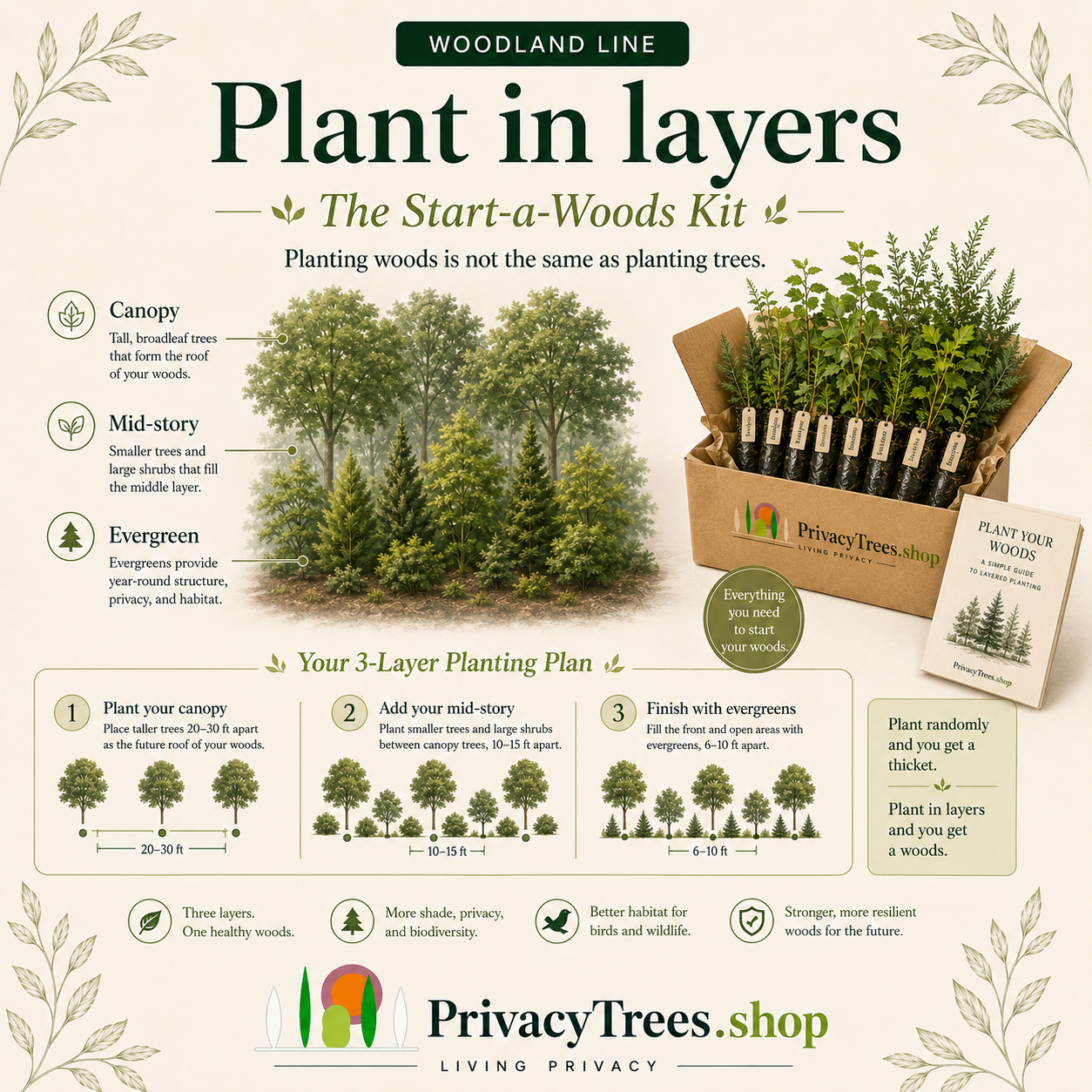 Image 2 of 5
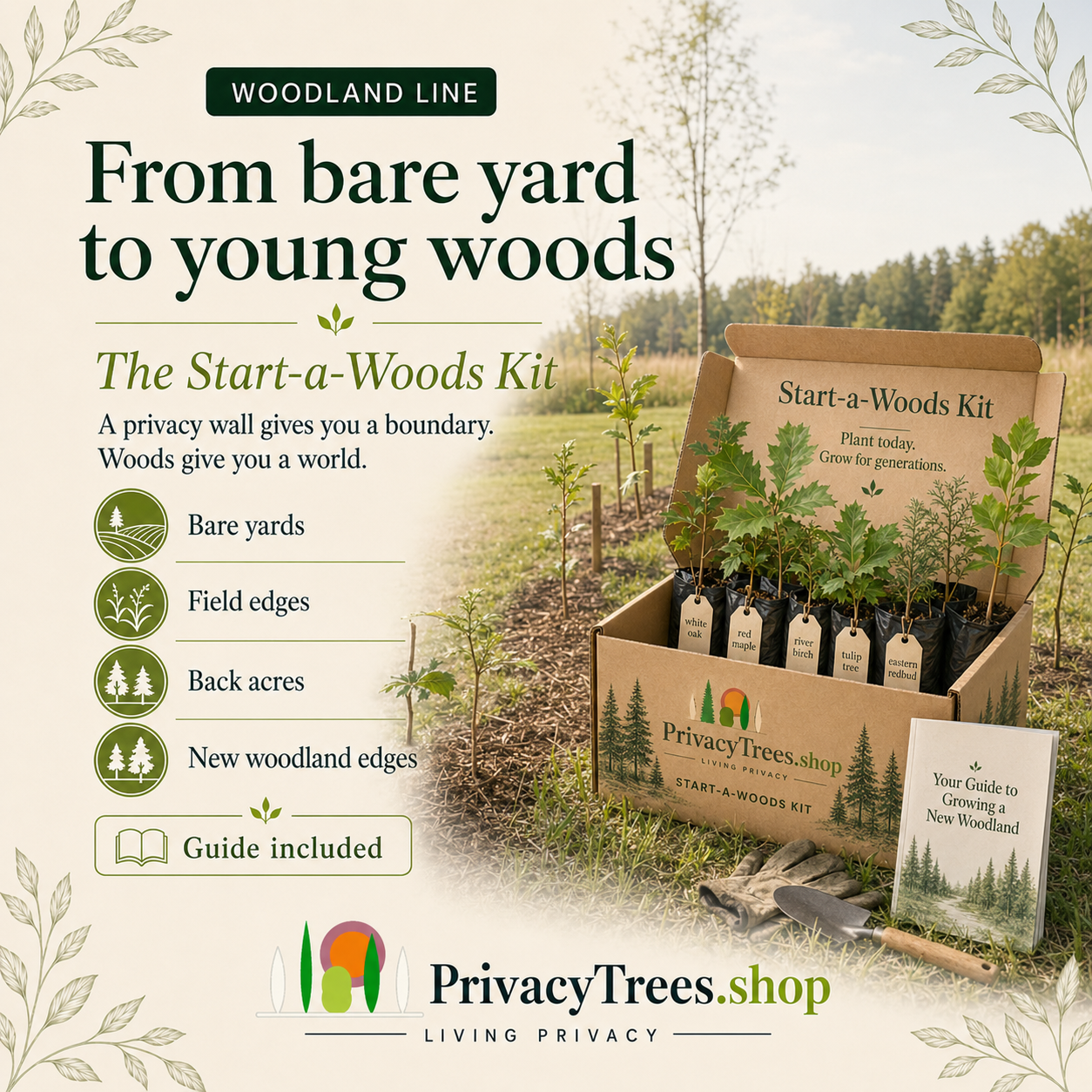 Image 3 of 5
 Image 4 of 5
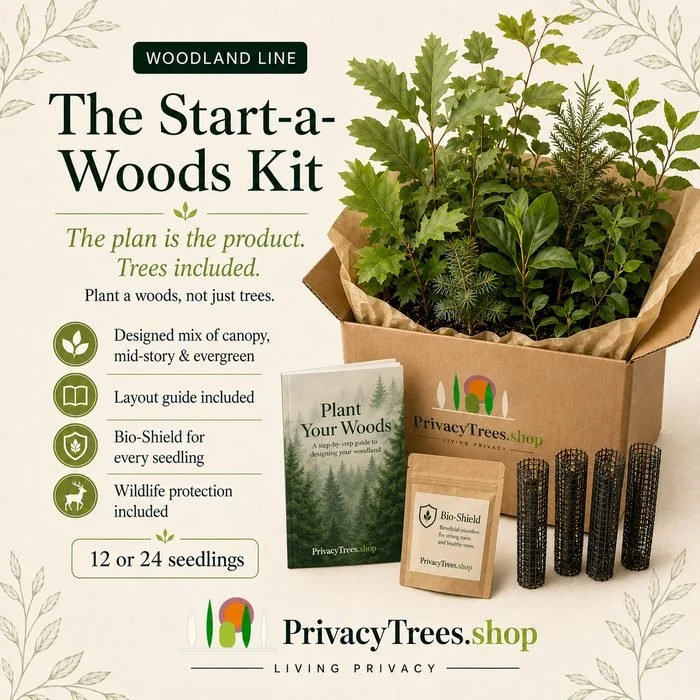 Image 5 of 5
You don’t need to know anything about trees. That’s the point of this kit.
Planting woods is not the same as planting trees. Real woods have layers — tall canopy trees, mid-story trees that fill and feather, evergreens that hold the structure in winter. Plant randomly and you get a thicket. Plant in layers and, in time, you get a forest that shades itself, feeds the birds, blocks the view, and gets better every single year.
This kit is the plan and the plants in one box: twelve wild-grown seedlings from our own sanctuary woods, chosen as a designed mix of canopy, mid-story, and evergreen — plus the layout guide that shows you exactly where each one goes, how far apart, and what to do (and not do) in the first year. We’ve included our Bio-Shield mycorrhizal inoculation for every seedling and wildlife protection for the ones deer find delicious.
A privacy wall gives you a boundary. Woods give you a world.
Twelve wild-grown seedlings in a designed mix of canopy, mid-story and evergreen — hand-dug from our sanctuary woods and potted on
The layout guide — where each seedling goes, how far apart, and the first-year do’s and don’ts
Bio-Shield mycorrhizal inoculation on every seedling
Wildlife protection for the species deer target hardest
Most of what’s in this box is deciduous hardwood — oaks, maples and their neighbours. The pines are the evergreens, and they’re there on purpose: they hold structure and screening through the months when everything else is bare.
Wild-collected seedlings vary. The exact species mix shifts with what the woods produced that season, and every seedling is labelled so you know what you have.
The mix isn’t a variety pack. Each layer is doing a different job, and the reason woods feel like woods is that all three are present.
Canopy — oaks, maples, tulip trees. The eventual roof. Slowest to matter, and the reason the whole thing works in thirty years.
Mid-story — the layer at eye level that fills the gaps, feathers the edges, and stops it reading as a plantation of poles.
Evergreen — pines, holding shape and screening all winter when the hardwoods are bare sticks.
Plant only canopy trees and you get a bare-trunked grove with nothing at eye level. Plant only fast fillers and you get thicket. The guide keeps you out of both.
Worth saying plainly, because it surprises people who have only planted evergreens before.
They will look dead all winter. Bare twigs, no leaves. Normal. Scratch a twig gently with a thumbnail — green underneath means alive.
Plant them dormant. Late autumn through early spring is the best window by a wide margin. A dormant seedling puts everything into roots before it has to support leaves.
Leaf-out is late in year one. Newly planted seedlings often wait weeks longer than established trees nearby. Don’t give up in April.
Only the pines stay green. If your winter view matters to you from day one, site the pines where you’ll be looking.
Year one is roots. Nothing above ground matters as much as water and keeping the deer off.
Water: deeply through the first growing season, more in heat. Dig down a few inches and feel the soil rather than watering on a schedule.
Mulch: a few inches in a ring around each seedling, pulled back from the stem.
Fertiliser: none. A seedling pushed into top growth before it has roots is a weaker tree.
Deer: the single biggest cause of failure on hardwood seedlings. A seedling browsed repeatedly at the growing tip never gets away. Use the protection that comes in the kit.
Competition: keep grass and weeds off the root zone for the first two years. Grass beats a seedling for water and usually wins.
Don’t prune. Let them do what they want for the first couple of years.
The Understory Bloom Kit — the flowering layer, for the edges and paths where light gets in.
The Fall Fire Kit — if autumn colour is what you’re really after.
The Forest Restock Box — for filling gaps in woods you already have, rather than starting from open ground.
Go touch a tree.