
 Image 1 of 4
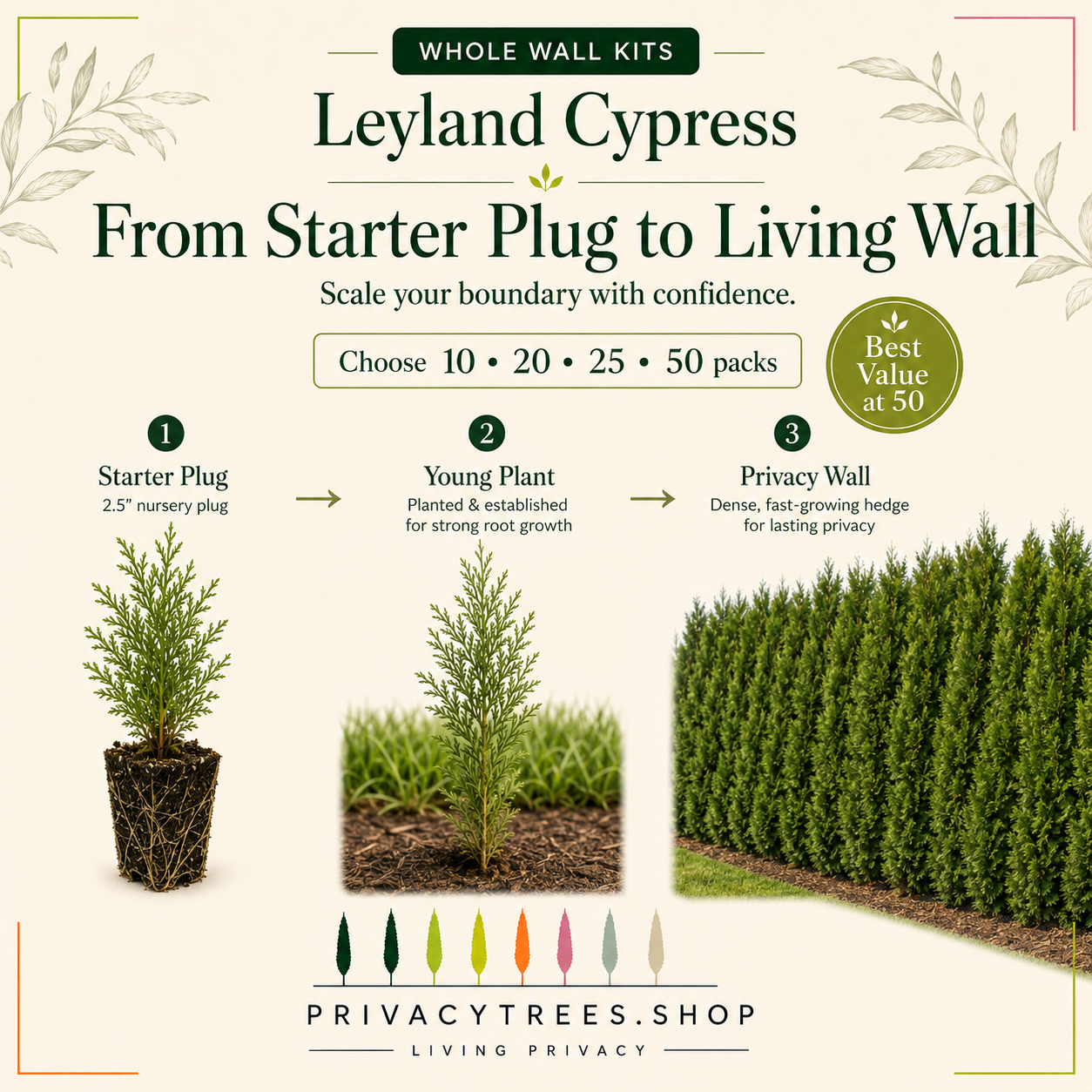 Image 2 of 4
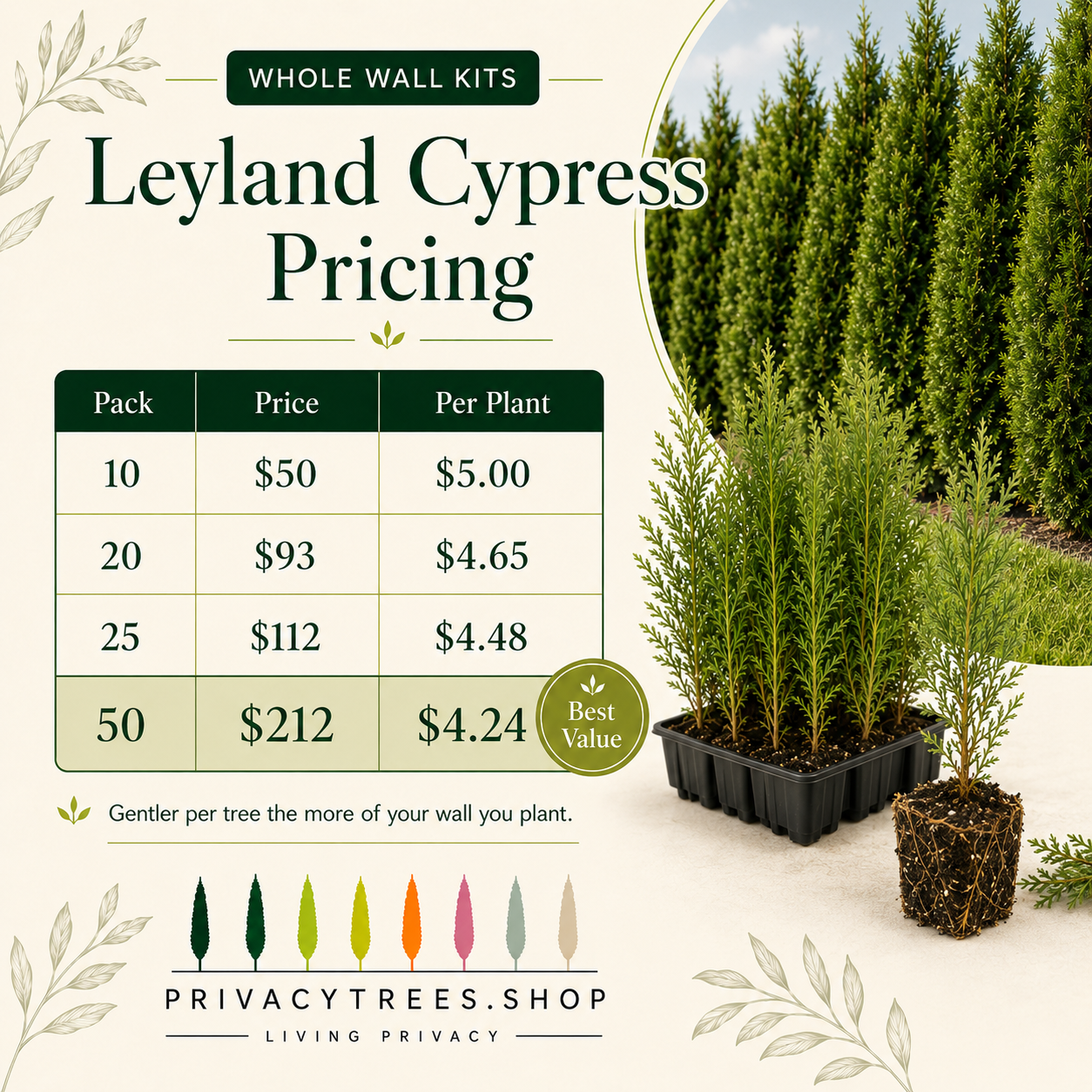 Image 3 of 4
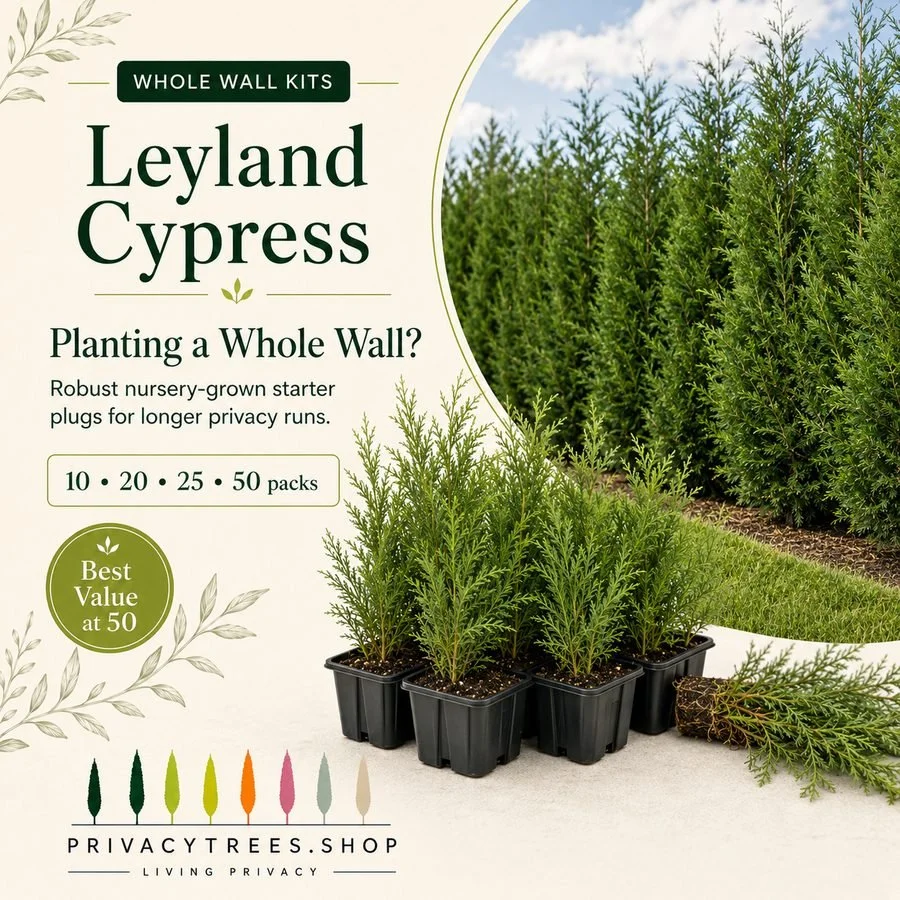 Image 4 of 4
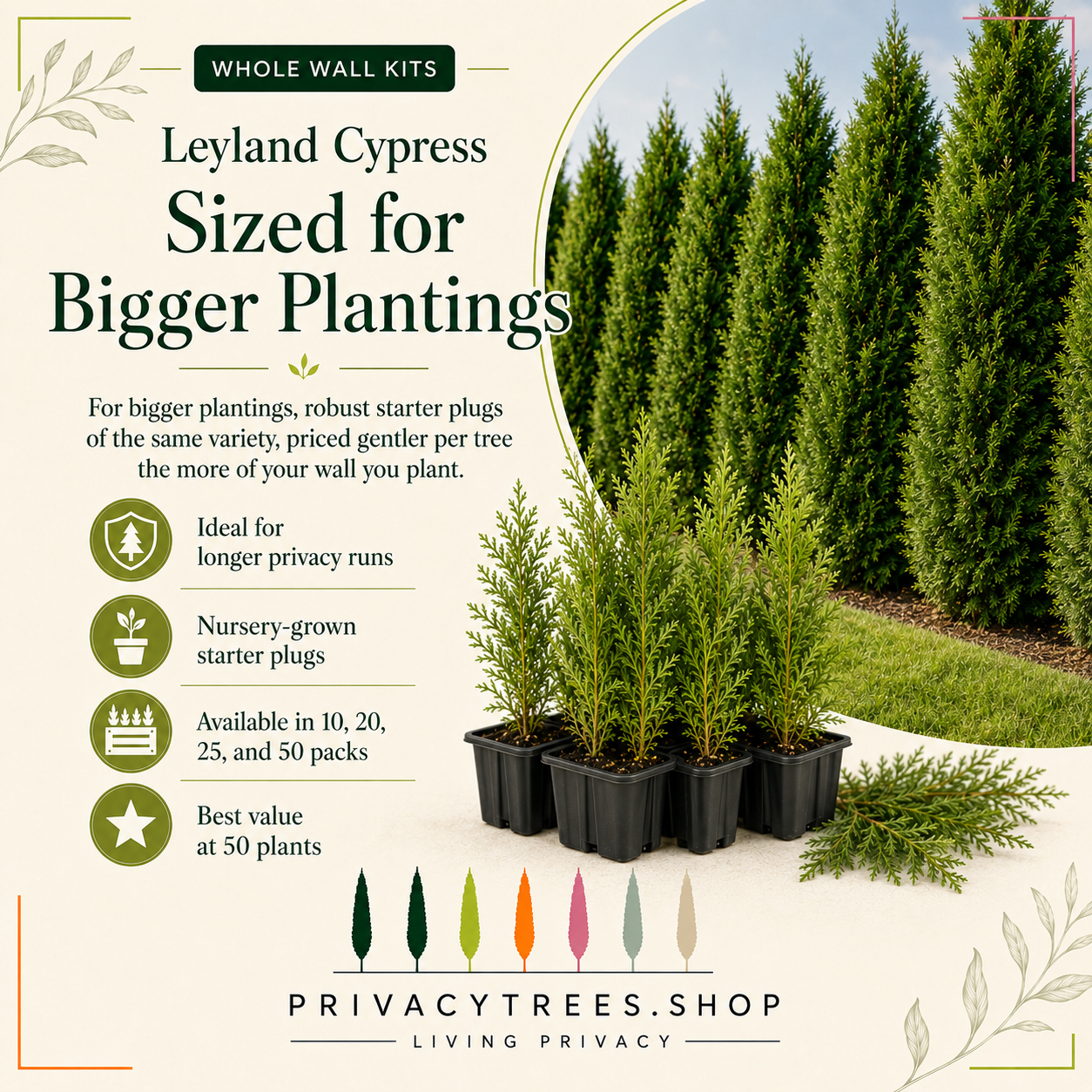
Everything you need to plant a full privacy wall in one go — Leyland Cypress starter saplings grown from our proven mother trees. Smaller saplings establish faster and fill in stronger than oversized nursery stock, giving your screen a real head start. Choose the pack size that matches your wall.
Leyland Cypress goes in at 8–12 ft on centre for a solid screen. Measure the run you want to cover, divide by your spacing, and add one for the end of the row.
10-Pack — covers roughly 80–120 ft of run
20-Pack — roughly 160–240 ft
25-Pack — roughly 200–300 ft
50-Pack — roughly 400–600 ft
Tighter spacing closes the gap sooner but crowds the row later; wider is healthier and slower. If you’re between two pack sizes, the larger one gives you spares — useful, because a few losses in the first year are normal on any planting this size.
Work out quantity and cost for your run
The instinct is to buy the biggest tree you can afford. On a long run it usually backfires.
A small sapling puts its energy into roots in year one. A large transplant spends that year recovering from being dug.
Root-to-shoot ratio matters more than height. Saplings arrive with proportionally more root, so they take off sooner.
You can plant a 50-pack of saplings with a shovel and a weekend. Fifty balled-and-burlapped trees need equipment and a crew.
Losses hurt less. On a wall of this size, a few plants will fail. Replacing a sapling is a minor annoyance.
Within three or four seasons a sapling row typically catches and passes a row planted from much larger stock — and costs a fraction as much.
Mark first, dig second. Run a string line and mark every planting spot at your chosen spacing before a single hole is dug. Rows drift otherwise.
Depth: top of the root ball level with the ground or an inch proud. Planting deep is the most common way these are lost.
Drainage: critical for Leyland — wet feet cause root rot. If water stands in a hole an hour after filling it, plant that spot on a low mound instead.
Mulch: 2–3 in out to the drip line, pulled back from each trunk.
Water in: deeply at planting, to settle soil around the roots rather than to wet the leaves.
Keep them shaded and damp until they go in the ground. Don’t unpack the whole order onto a sunny driveway.
View the Complete Planting & Care Guide
Watering one tree is easy. Watering fifty is a logistics problem, and it is the thing that decides whether your wall succeeds.
Sort out water before you plant. A soaker hose down the row costs little and saves the planting. Hand-watering a 200 ft run gets old by July.
Water deeply and regularly through the first growing season, more in heat. Check by digging down 4 inches rather than watering on a schedule.
Fertiliser: none at planting. Roots first.
Winter: evergreens keep transpiring in winter. Water during a dry, unfrozen spell.
Wildlife: young plants are the vulnerable ones. Protect the first two winters where deer or rabbits are active.
Airflow: Leyland is prone to bagworms and canker in still, crowded conditions. Don’t plant tighter than 8 ft just to close the gap sooner.
Mycorrhizal Bio-Shield — root-zone fungi that extend what the roots can reach. Most useful on the smallest sizes, where root volume is the limit on how fast the tree gets going.
Wildlife Protection Bundle — Leyland Cypress is not reliably deer-proof, and a hungry winter can strip a young one.
Safe-Zone Up-Potting — if the bed won’t be ready this season, grow them on a season before committing them to the ground.
These are the same trees sold individually on the Leyland Cypress page — hardiness, mature size, soil, deer tolerance, and whether this species suits your space are all covered there in full.
Read the complete Leyland Cypress profile
Privacy Wall Visualizer — upload a photo of the actual spot and see the wall at the spacing you’re considering.
Privacy Timeline Calculator — how long until it’s a wall.
Measure the run — length, and how wide the bed can be
Confirm a mature 12–20 ft spread will fit without crowding a fence or drive
Check the hours of direct sun that line actually gets
Divide the run by 8–12 ft to get your count, then round up
Plan how water reaches the far end of the row
Decide on wildlife protection if deer come through
Read the planting guide before the trees arrive, not after
Our small-batch pedigree saplings are grown from named mother trees on our sanctuary property, rooted with attention, and selected for resilience, structure, and the ability to survive the first year. These are living trees — availability may vary by batch, season, and plant readiness.
Everything you need to plant a full privacy wall in one go — Leyland Cypress starter saplings grown from our proven mother trees. Smaller saplings establish faster and fill in stronger than oversized nursery stock, giving your screen a real head start. Choose the pack size that matches your wall.
Leyland Cypress goes in at 8–12 ft on centre for a solid screen. Measure the run you want to cover, divide by your spacing, and add one for the end of the row.
10-Pack — covers roughly 80–120 ft of run
20-Pack — roughly 160–240 ft
25-Pack — roughly 200–300 ft
50-Pack — roughly 400–600 ft
Tighter spacing closes the gap sooner but crowds the row later; wider is healthier and slower. If you’re between two pack sizes, the larger one gives you spares — useful, because a few losses in the first year are normal on any planting this size.
Work out quantity and cost for your run
The instinct is to buy the biggest tree you can afford. On a long run it usually backfires.
A small sapling puts its energy into roots in year one. A large transplant spends that year recovering from being dug.
Root-to-shoot ratio matters more than height. Saplings arrive with proportionally more root, so they take off sooner.
You can plant a 50-pack of saplings with a shovel and a weekend. Fifty balled-and-burlapped trees need equipment and a crew.
Losses hurt less. On a wall of this size, a few plants will fail. Replacing a sapling is a minor annoyance.
Within three or four seasons a sapling row typically catches and passes a row planted from much larger stock — and costs a fraction as much.
Mark first, dig second. Run a string line and mark every planting spot at your chosen spacing before a single hole is dug. Rows drift otherwise.
Depth: top of the root ball level with the ground or an inch proud. Planting deep is the most common way these are lost.
Drainage: critical for Leyland — wet feet cause root rot. If water stands in a hole an hour after filling it, plant that spot on a low mound instead.
Mulch: 2–3 in out to the drip line, pulled back from each trunk.
Water in: deeply at planting, to settle soil around the roots rather than to wet the leaves.
Keep them shaded and damp until they go in the ground. Don’t unpack the whole order onto a sunny driveway.
View the Complete Planting & Care Guide
Watering one tree is easy. Watering fifty is a logistics problem, and it is the thing that decides whether your wall succeeds.
Sort out water before you plant. A soaker hose down the row costs little and saves the planting. Hand-watering a 200 ft run gets old by July.
Water deeply and regularly through the first growing season, more in heat. Check by digging down 4 inches rather than watering on a schedule.
Fertiliser: none at planting. Roots first.
Winter: evergreens keep transpiring in winter. Water during a dry, unfrozen spell.
Wildlife: young plants are the vulnerable ones. Protect the first two winters where deer or rabbits are active.
Airflow: Leyland is prone to bagworms and canker in still, crowded conditions. Don’t plant tighter than 8 ft just to close the gap sooner.
Mycorrhizal Bio-Shield — root-zone fungi that extend what the roots can reach. Most useful on the smallest sizes, where root volume is the limit on how fast the tree gets going.
Wildlife Protection Bundle — Leyland Cypress is not reliably deer-proof, and a hungry winter can strip a young one.
Safe-Zone Up-Potting — if the bed won’t be ready this season, grow them on a season before committing them to the ground.
These are the same trees sold individually on the Leyland Cypress page — hardiness, mature size, soil, deer tolerance, and whether this species suits your space are all covered there in full.
Read the complete Leyland Cypress profile
Privacy Wall Visualizer — upload a photo of the actual spot and see the wall at the spacing you’re considering.
Privacy Timeline Calculator — how long until it’s a wall.
Measure the run — length, and how wide the bed can be
Confirm a mature 12–20 ft spread will fit without crowding a fence or drive
Check the hours of direct sun that line actually gets
Divide the run by 8–12 ft to get your count, then round up
Plan how water reaches the far end of the row
Decide on wildlife protection if deer come through
Read the planting guide before the trees arrive, not after
Our small-batch pedigree saplings are grown from named mother trees on our sanctuary property, rooted with attention, and selected for resilience, structure, and the ability to survive the first year. These are living trees — availability may vary by batch, season, and plant readiness.